Green Kitchen

Go Green in the Kitchen


by: Jay Fruin

It has taken over forty years for the environmental movement to become mainstream, but thankfully it finally has happened. Maybe it was the threat of global warming or the high cost of energy that was the catalyst – whatever the reason going green is a long-term trend we should all welcome.


Bamboo Kitchen Cabinets
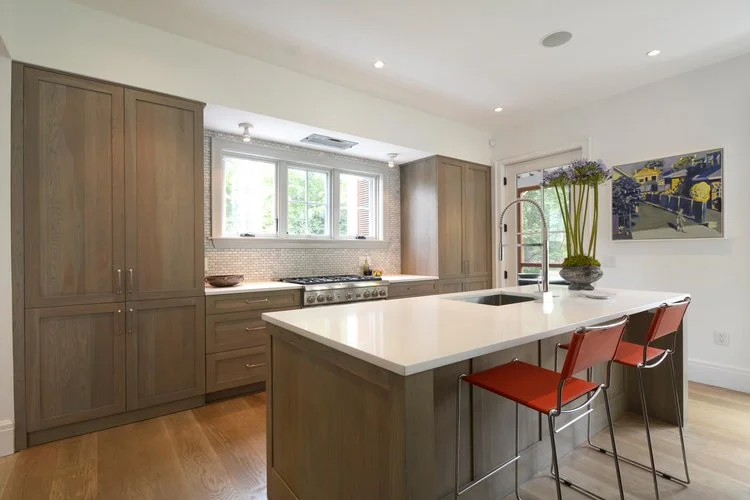
Bamboo kitchen - Sag Harbor, New York

Given that going green is a design consideration, there is no room in a house where that consideration is more important than the kitchen. As the central hub of activity in most homes, designing it as a green space has a dramatic affect on the overall “greenness” of a home.


If you are planning a kitchen project, it is worth some time to consider the various green options now you have. Green design options have grown significantly in the last few years and span almost all aspects of kitchen construction. In addition to product and material choices, you also have other considerations – like transportation costs. Transportation costs have now made their way into the energy calculation, so it’s wise to give that some thought too. Before we dig into kitchen specifics, let’s talk briefly about things we should consider when thinking green;


...according to the US Department of Energy the kitchen accounts for 41.5% of a home’s energy consumption.


    Chemicals used in the construction process
  • Many building products use toxic chemicals (typically urea-formaldehyde) in glues, adhesives and sealers. These chemicals have adverse affects on the environment and can cause health problems. Most (not all) plywood and particleboard products use toxic chemicals as binding agents. It’s worth researching the products used in your project in an effort to minimize toxic chemical use.

  • Ongoing energy consumption
  • A good deal of energy is consumed in a kitchen so it is wise to consider the appliance alternatives you may have. The biggest consumers of energy in a kitchen are the refrigerator, electric range/oven and microwave. Recent improvements in energy efficiency are dramatic and some states and electrical utilities provide incentives for purchasing energy efficient appliances.

  • Materials
  • Sustainability has been a serious consideration for quite some time – primarily driven by the global harvesting of exotic woods. The growing use of bamboo for cabinet framing, facing and flooring is a positive step in dealing with sustainability, but consideration should be given to other reneweable materials, as well.

  • Reusability
  • Part of the new green consciousness is the awareness of reuse. After all, if we reuse something it replaces the need for a new thing to take its place. Little additional energy or material is needed to reuse something. Of course, stripping, painting or refinishing the object should be taken into consideration when considering its reuse.

  • Transportation costs
  • The energy expended to get materials to your job site can be significant. For example, the energy required to ship a sheet of granite (ship and truck) to the fabrication yard and then onto your jobsite (truck). Give consideration to transportation costs when selecting all components of your project.

So let’s take a look at various aspects of a kitchen project and consider different alternatives;


Cabinet construction

Cabinets are frequently constructed of wood products. Some steel cabinet alternatives are available but wood construction is by far the most common. Wood cabinets can range from 100% manufactured wood products to 100% natural wood products but the most common construction is a combination of both manufactured (frame) and natural wood products (door and drawer faces) are used.

Bamboo cabinet
Bamboo cabinet construction

Simply choosing a natural wood doesn’t necessarily make a good green choice. Consider that some natural wood products used in cabinet-making are from environmentally unsustainable sources while other wood products use unhealthy substances such as urea formaldehyde and vinyl. Reclaimed wood products have grown in popularity and provide a great alternative as a natural cabinet wood. Consideration should always be given to the sustainability of the wood products used in the cabinet's construction.


As mentioned earlier, bamboo is an amazing material due to its incredible growth rate (I have personally seen it grow almost 12 inches in one day). It is considered a highly eco-friendly alternative to wood for this very reason. Due to its fiborous makeup, bamboo is very strong and can be used in cabinet frames, faces and doors. Bamboo is not for everyone but definatley worth a look - you will be pleasantly surprised by it.


Also consider the finish used on the cabinet. Finishes traditionally have contained toxic chemicals and have required additional toxic chemicals for clean-up. The use of a natural low-VOC (volatile organic compound) finish like linseed oil or beeswax will reduce the amount toxic chemicals in the kitchen. In addition to these natural finishes, many manufacturers have introduced low-VOC paint alternatives.


Another new option for cabinet construction is wheatboard or strawboard. Panels are made from this material by compressing straw. The finished strawboard is made without toxic binders. hese products are relatively new to the market so you may have to search a bit to find them.


LED lighting technology uses 30-90% less energy than conventional (halogen, incandescent, fluorescent) lighting.


Lighting

The best thing you can do as a green designer is to maximize natural-light to minimize artificial lighting needs. Adding a skylight, solar tube or increasing window size are alternatives that improve the flow of natural light.


LED Lighting
LED kitchen lighting

As far as artificial lighting is concerned, the most exciting development to occur in kitchen lighting is the availability of LED (light-emitting diodes) lighting fixtures. This new technology uses 30-90% less energy than conventional (halogen, incandescent, fluorescent) lighting. In addition, LED lights don’t have filaments, don’t heat up, don’t burn out and last 10-30 times longer than traditional alternatives. The downside is their cost. Because LED lights are still new technology they cost significantly more than conventional lighting – 3 to 10 times as much. Despite their cost, they are defiantly the greenest alternative for lighting in the kitchen.


A practical solution for reduced energy consumption for lighting is the use of Compact Fluorescent Light (CFL) bulbs. They are an inexpensive alternative in the green lighting formula consuming about 60% less energy than an incandescent or halogen bulb.


Poured concrete countertop (Cheng Design)
Countertops

Choices in countertop surfacing have sky-rocketed in the past few years. Gone are the days where your only choice was selecting a laminate color chip. Today’s choices span a wide gamut of materials that all provide the same function – acting as a durable, easy to clean work surface in your kitchen.

Material choices now include, manufactured quartz (Caesarstone, Silestone,), recycled paper and wood(RichLite, shetkaStone), recycled aluminum(Alkemi), recycled glass (Enviroglass, Vetrazzo, Bioglass, , Icestone), concrete(Syndcrete, Squak Mountain Stone), recycled wood(Ecotop, Craft Art Company, Endura Wood Products).


Choosing the “greenest” approach to countertop solutions is perhaps the most difficult debate. You really span the spectrum of trade-offs when considering your countertop choices. On one end of the spectrum, you could argue that a “poured in place” concrete countertop is the greenest approach due to the low cost of transportation. Labor costs are high, but material costs and energy expended in transportation costs are low. On the other end, you could argue that a particleboard top surfaced with a glued synthetic laminate is the most harmful to the environment – yet possibly the least expensive.


The choices in the middle are quite vast, ranging from manufactured quartz (the most plentiful mineral on the planet) to a solid exotic hardwood (very limited supply) top. Natural materials – like granite and marble – are currently the most popular tops – but even they have the drawback of requiring a lot of energy to transport the material from the quarry to your jobsite.


Appliances

OK, so we know that our kitchen space uses a lot of energy but what you may not know is that according to the US Department of Energy the kitchen accounts for 41.5% of a home’s energy consumption. Updating kitchen appliances to energy efficient models can have a dramatic effect on the energy consumption in the home. To make it easier for us to figure out the energy consumption of an appliance, the Department of Energy test them to determine the annual cost of operating it. Once tested it is assigned an Energy Star rating. The manufacturer then includes that rating along with the specifications for that appliance allowing easy comparison.


Plumbing

There are two aspects of kitchen plumbing that should be taken into consideration as we explore green alternatives. Both the quality of water and the amount of water used are areas to explore. Water quality can be impacted by sources outside and inside the home. The use of PEX tubing instead of the traditional copper piping with lead soldered joints will eliminate the potential for lead poisoning and at the same time reduce the use of cooper – a commodity that is in great demand and growing more expensive each day.


Filtering your water supply to both the faucets and ice maker should be given careful consideration. Installing low-flow (WaterSense) water faucets will reduce the amount of water you use while minimally affecting your kitchen lifestyle.


As we have seen, environmentally conscious kitchen design can have a dramatic affect on your home’s energy consumption as well as improve your family’s quality of life. Adopting green building practices forces us to be wiser in our use of natural resources in order to prevent damage to our environment. All it takes is a little time and research to better understand the environmental trade-offs of the products and processes used in your project.


Sample Go-Green Kitchen

So, given all of the above let’s have some fun and design a green kitchen.


Cabinetry

Bamboo cabinetry (frame, door and drawer faces) non-formaldehyde plywood) - unpainted


Countertop

Concrete countertop (poured in place) with recycled glass aggregate


Backsplash

Recycled glass tile backsplash


Lighting

Solar overhead tube and LED lighting (under-counter and overhead)


Flooring

Reclaimed wood – pine with beeswax finish


Appliances

Gas – stove/range
Energy-efficient Microwave, refrigerator, dishwasher(water-saving)

Water
Filtered water (sink and refrigerator)
WaterSense (low flow) faucets


Resources

Alkemi www.renewedmaterials.com
Bioglass www.coveringsetc.com
Caesarstone www.caesarstoneus.com
Craft Art Company www.craft-art.com
Ecotop www.kliptech.com
Endura Wood Products www.endurawood.com
Energystar.gov www.energystar.gov
Enviroglass www.enviroglasproducts.com
PEX www.pexinfo.com/
Richlite www.richlite.com
Silestone www.silestoneusa.com
Shetkastone www.shetkastone.com
Squak Mountain Stone www.squakmountainstone.com
Syndcrete www.syndesisinc.com
The Daily Green www.thedailygreen.com
Vetrazzo www.vetrazzo.com
WaterSense www.epa.gov/watersense